Splitting trip costs paid in a foreign currency
Card rates, foreign transaction fees and conversion at the terminal: how a group can share costs paid abroad without arguing over cents.
On this page
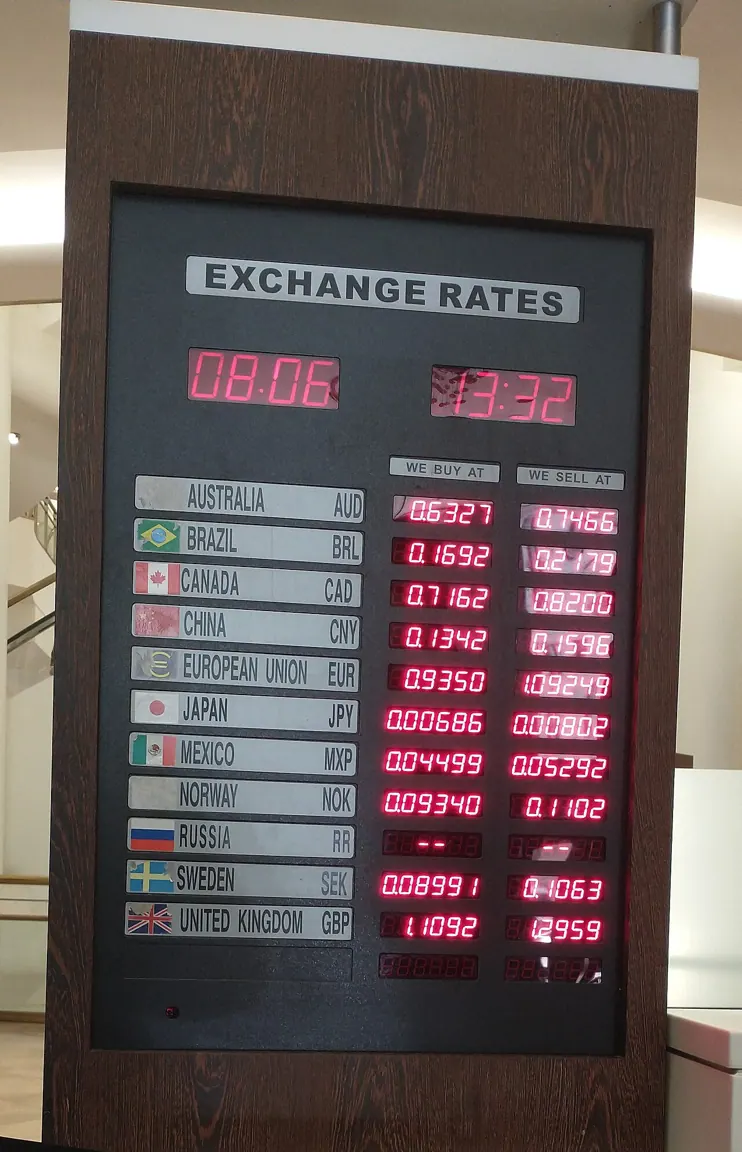
On a trip abroad, the menu shows pesos and the bank shows dollars. Between the two, each card applies its own exchange rate, sometimes a foreign transaction fee, and the terminal may offer to convert the price on the spot. Three friends can pay the same amount in local currency and see three different charges. Before splitting anything, the group needs to agree on one account currency and on who carries those conversion costs.
Why the charged amount differs from the price
Three things can separate the local price from the amount on a statement. The first is the rate used by the card network or the bank. The second is a fee set by the card issuer for purchases in a foreign currency, which varies by card and can be zero. The third happens at the counter: the terminal or the merchant offers to charge you in your home currency right away. This option is called dynamic currency conversion, or DCC. The rate is set by the merchant’s provider, not by your bank, and it often includes a margin.
In the United States, Regulation Z requires credit card issuers to treat their own conversion fees, and network fees passed on to the cardholder, as part of the cost of credit. The official commentary also states that an issuer does not have to disclose a fee imposed by a merchant, such as a merchant’s own conversion. In practice, the price of DCC is the one shown on the terminal screen, so that screen is where the decision is made.
For European travelers, EU rules on cross-border payments go further. For card payments in another currency of the Union, the total conversion charges must be expressed as a percentage mark-up over the latest euro reference rates of the European Central Bank and shown before the payment. This applies to the party offering conversion at the terminal as well. It does not cover a purchase in pesos or in US dollars.

One trip, two ways to count
This example is fictional and uses an invented round rate: $1 = 20 Mexican pesos. Sam, Priya and Leo spend a weekend in Mexico City and split everything equally. Sam books the hotel for 9,600 pesos, $480 at that rate. His card adds its own costs and his bank charges $486.00. Priya pays dinner, 2,400 pesos or $120. She accepts the terminal’s offer to pay in dollars and is charged $129.00. Leo pays nothing during the trip.
First method: record what each bank actually charged. The trip costs $615 in total, $205 per person. Sam paid $486 and should receive $281. Priya paid $129 and owes $76. Leo owes $205. The card fee and the terminal margin, $15 in total, are shared by all three.
Second method: record each expense at a rate the group agrees on, and leave each person’s own card costs with them. The trip then costs $600, $200 each. Sam should receive $280, Priya owes $80 and Leo owes $200. Sam’s real cost is $206, because he keeps his $6 fee. Priya’s is $209, because she keeps the $9 she lost by accepting DCC. Leo’s is $200.
Both results add up. The difference is a group choice, not a math error. Sharing the charged amounts is simple when everyone uses similar cards. Keeping card costs individual is fairer when one person pays with a card that has no foreign fee and another with a card that has one.

Agree before the first payment
- Choose one account currency for the trip, usually the one most of the group earns and spends at home.
- Decide the method: charged amounts shared by everyone, or a common rate with card costs kept by each payer. If you use a common rate, say which one and on which date.
- Write down the local price and the amount finally charged. A card notification can show a provisional amount; the statement shows the final one.
- At the terminal, choosing to pay in local currency lets your own bank do the conversion. Whether that is cheaper depends on your card’s terms, so check them before leaving.
- Agree on what happens when someone accepts DCC: is the margin shared or kept by that person?

Cash withdrawals and refunds follow the same logic
A cash withdrawal abroad can add an ATM operator fee to the card’s own costs. If the cash then pays for the whole group, record the amount spent in local currency and decide, as for cards, whether the withdrawal fees are shared. A refund in a foreign currency can also come back at a different rate than the original purchase. Record the amount actually received, as in a canceled booking, rather than reversing the original charge.

Keep the trip in one place
Whatever method the group picks, everyone should be able to see the same entries: the expense, the payer, the participants and the amount used for the split. Spliz lets a group record those expenses and see each person’s share and balance. Recording a repayment in the app does not send money; friends repay by bank transfer, in cash or with another app, then note it.
Group trip budget template · Splitting a refund after a canceled booking
Sources
- Consumer Financial Protection Bureau, Regulation Z official commentary on § 1026.4, foreign transaction fees.
- Regulation (EU) 2021/1230, cross-border payments in the Union, Article 4 on card currency conversion charges.
- European Central Bank, euro foreign exchange reference rates.
- Spliz
Friends first. Enjoy the good times.