Birthday dinner: how to split the bill as a group
A worked example for treating the birthday person: their share, the cake, a friend who leaves before dessert, the tip and who pays the restaurant.
On this page
When a group treats the birthday person, the bill no longer splits by the number of people at the table. One person eats without paying, someone may leave early, a friend brought the cake and another put the restaurant on their card. The simplest fair method is to calculate each person’s own share first, then divide the guest of honor’s share among the hosts.
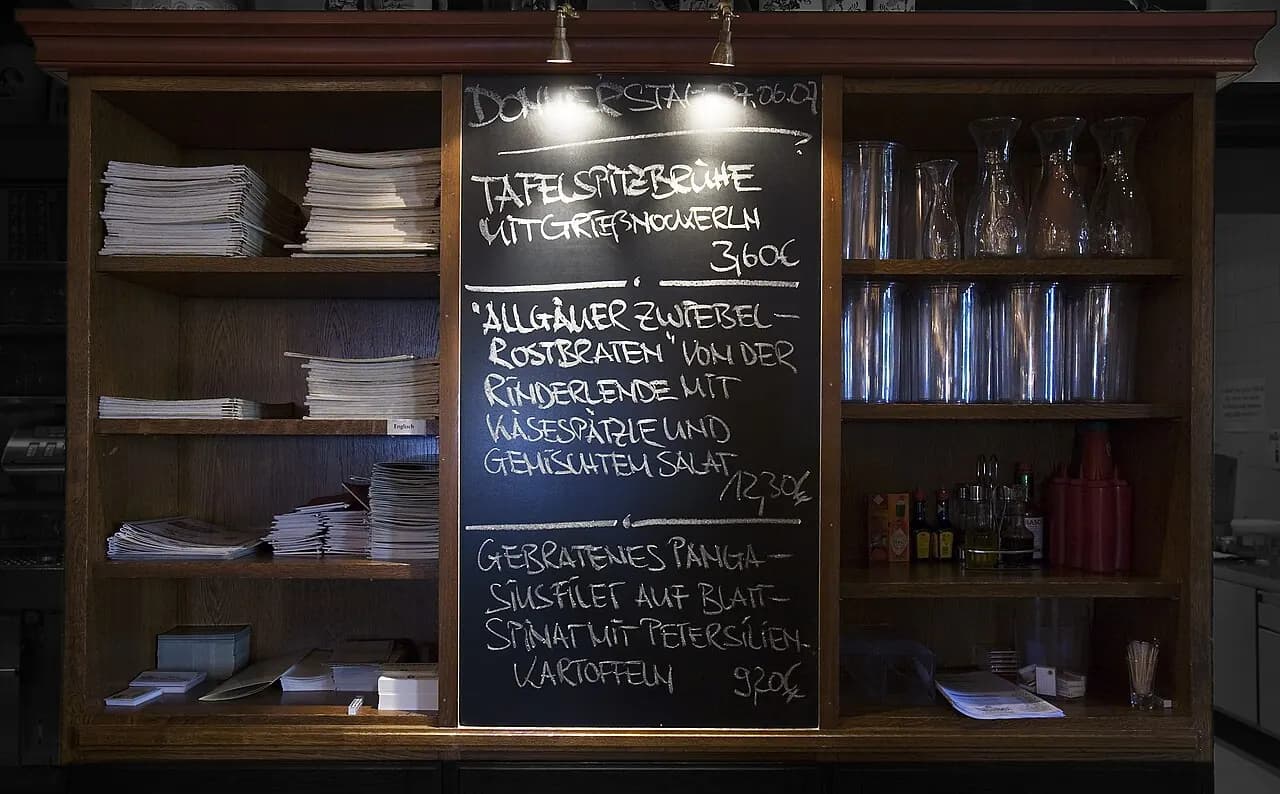
Decide who is treating, before the bill arrives
Settle three points in the group chat before the dinner: who covers the birthday person’s meal, whether that includes drinks and dessert, and whether the cake and the present are separate expenses. Agreeing in advance avoids a negotiation at the table, in front of the person you are celebrating.
The usual answer is that everyone else at the table shares the guest of honor’s share equally. Some groups exclude a friend who could only come for drinks, or ask a partner to cover more. Any of these choices works if it is said before the bill is split, not discovered afterward.

A worked example with an early departure
This example is fictional. Six friends have dinner for Sam’s birthday: Sam, Noah, Ava, Leo, Mia and Jordan. The bill comes to $300 before tip, including tax. Of that, $270 covers the shared mains and drinks for all six. The other $30 is for five desserts: Leo left before dessert. The group agrees on a 20% tip, so the restaurant receives $360.
Apply the tip to each part of the bill. The mains become $324, or $54 per person. The desserts become $36, or $7.20 for each of the five people who stayed. Sam’s own share is $54 plus $7.20, so $61.20. Split among the five hosts, that is $12.24 each.
- Leo pays his main share and his part of Sam’s: $54 + $12.24 = $66.24.
- Noah, Ava, Mia and Jordan each pay main, dessert and their part of Sam’s: $54 + $7.20 + $12.24 = $73.44.
- Sam pays nothing.
Check the total: $66.24 plus four times $73.44 is $360, the amount paid to the restaurant. Here Leo still helps pay for Sam’s dessert, because the group decided that the whole meal is a shared present. If your group prefers that Leo only covers what happened while he was there, divide Sam’s dessert among the four who stayed instead. Both rules are defensible; pick one and apply it to everyone.
For a dinner where some people do not drink, the same logic applies to drinks: see how to split a dinner bill when someone does not drink.

Tip and service charges depend on the country
In the United States, the IRS describes tips as discretionary payments that customers choose to give. A service charge added to the bill by the restaurant is not a tip. Read the bill before adding anything: a large-party service charge may already be included, and adding 20% on top would pay twice.
In France, a restaurant that charges for service must show prices as net prices, tax and service included, with the words “prix service compris” and the rate applied, according to the Paris Île-de-France chamber of commerce. A tip is then an extra the group may decide to leave. Whatever the country, decide the amount together and spread it in proportion to each part of the bill, as above.

Keep the cake and the present as separate expenses
In the example, Ava bought a $40 cake. It is shared by the five hosts, $8 each, and it is recorded as its own expense with Ava as the payer. Mixing it into the restaurant bill would hide who advanced the money. The final cost for the evening becomes $74.24 for Leo and $81.44 for each of the other four hosts, a total of $400 for the dinner and the cake.
A shared present follows the same principle, with its own budget. For a worked method, see how to budget a group gift.

One card at the table, clear repayments afterward
Many restaurants prefer a single payment for a large table. In the example, Noah pays $360. He is owed $66.24 by Leo and $73.44 each by Ava, Mia and Jordan, a total of $286.56. Ava is owed $8 by each of the other four hosts for the cake. Write these amounts down that evening, while everyone remembers who stayed for dessert.
In Spliz, a group can add the dinner and the cake as two expenses, choose who shares each one and see each person’s balance. Friends join as guests by installing the app, without creating an account. The app does not move money: repayments are made by bank transfer, in cash or with another app, then recorded so the group knows they are done.
Sources
- IRS, Tip recordkeeping and reporting, definition of tips and service charges in the United States.
- CCI Paris Île-de-France, mandatory displays in a restaurant, French rule on prices shown with service included.
Put the numbers into practice. Track what each friend paid in Spliz.