How to split the tip on a group restaurant bill
Tip before or after tax, in proportion or equally, a service charge already on the bill: a worked example for a group, checked to the cent.
On this page
The food is split, then someone asks how much to leave. A tip on a group bill raises three questions the menu does not answer: whether service is already charged, what amount the tip is calculated on, and whether everyone pays the same tip or a tip in proportion to what they ordered. Settling them in that order gives a total that adds up.
Read the bill before adding anything
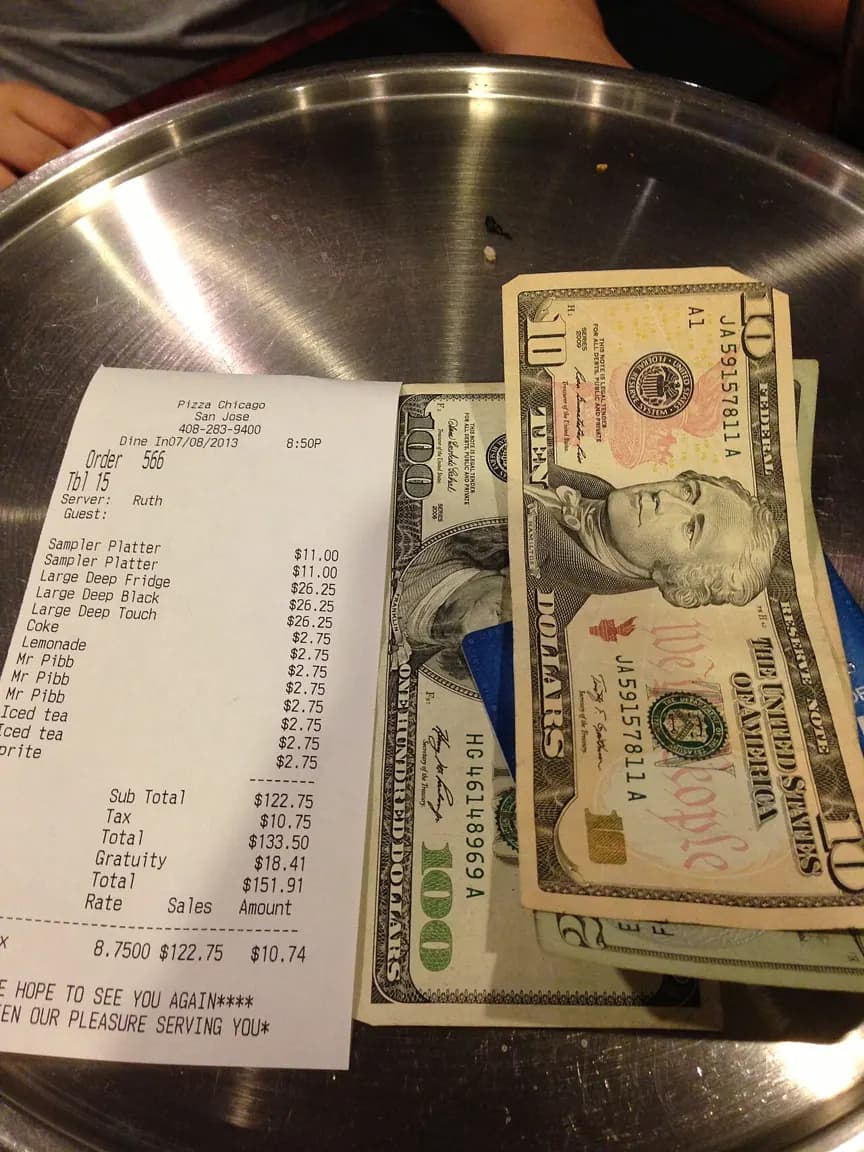
In the United States, the IRS defines tips as discretionary payments that customers voluntarily give. Extra amounts added to the bill by the restaurant, such as mandatory service charges, sometimes called auto-gratuities, are not tips. In a ruling on the subject, the IRS describes a restaurant whose menu adds an 18% charge for parties of six or more: that amount is a service charge, not a tip.
For a group, the practical consequence is simple. Look for a service charge line before anyone calculates a tip. If it is there, the group has already paid for service, and anything extra is a choice to make together, not a second 20% added by habit.
In France, a restaurant that charges for service shows net prices, tax and service included, with the words “prix service compris” and the rate applied, according to the Paris Île-de-France chamber of commerce. A tip is then an optional extra. When you travel, read the menu and the bill for the same kind of mention rather than relying on a rule of thumb.
Before or after tax: choose the base once
This example is fictional. Nora, Tom, Ines and Paul have dinner where sales tax is added to menu prices and a tip is expected. Before tax, Nora ordered $50, Tom $45, Ines $40 and Paul $25, a $160 bill. With an 8% tax used for the example, the tax is $12.80 and the bill reaches $172.80.
A 20% tip on the amount before tax is $32.00. On the amount after tax it is $34.56, so $2.56 more. Neither base is a legal rule; it is the group’s decision. What matters is applying the same base to everyone and saying it before the calculation, so nobody redoes the math with another percentage.

Proportional or equal: what changes for the light eater
Keep a 20% tip before tax. In proportion, each person pays their order, the 8% tax and 20% of their order, so 1.28 times what they ordered:
- Nora: $50 + $4.00 + $10.00 = $64.00.
- Tom: $45 + $3.60 + $9.00 = $57.60.
- Ines: $40 + $3.20 + $8.00 = $51.20.
- Paul: $25 + $2.00 + $5.00 = $32.00.
The total is $204.80: $160 of food, $12.80 of tax and $32 of tip. If the group splits the tip equally instead, each person adds $8.00. Nora pays $62.00, Tom $56.60, Ines $51.20 and Paul $35.00, the same $204.80 in total. Paul, who had a salad and water, pays $3.00 more; Nora pays $2.00 less.
A proportional tip follows the bill, so it is usually the one that surprises nobody. An equal tip is simpler to say at the table. Both are fair if they are chosen before the bill is split. The same reasoning applies to drinks: see how to split a dinner bill when someone does not drink.

A card for the bill, cash for the tip
Often one person pays the bill by card and another leaves the tip in cash. Treat them as two expenses with two payers. In the example, Nora pays $172.80 by card and Tom leaves $32.00 in cash. With the proportional shares, Nora has advanced $108.80 more than her $64.00 share. Tom has advanced $32.00 against a $57.60 share, so he still owes $25.60.
Tom sends $25.60 to Nora, Ines $51.20 and Paul $32.00. That is $108.80, exactly what Nora advanced beyond her share. Leaving the cash tip out of the record would make Tom look like he owes $57.60 and pay twice.
Abroad, the card may be charged in another currency. For that case, see how to split trip expenses in a foreign currency. A birthday dinner where the group treats one person follows the same steps, with one more share to spread: see how to split a birthday dinner bill.

Write it down that evening
In Spliz, a group can add the bill and the cash tip as two expenses, each with its payer, choose who shares each one and see each person’s balance, for free. Friends join as guests by installing the app, without creating an account. The app does not move money: repayments are made by bank transfer, in cash or with another app, then recorded so the group knows they are done.
Sources
- IRS, Tip recordkeeping and reporting, definition of tips and of service charges, which are not tips.
- IRS, Internal Revenue Bulletin 2012-26, Rev. Rul. 2012-18, example of an 18% charge for parties of six or more treated as a service charge.
- CCI Paris Île-de-France, mandatory displays in a restaurant, French rule on prices shown with service included.
Put the numbers into practice. Track what each friend paid in Spliz.